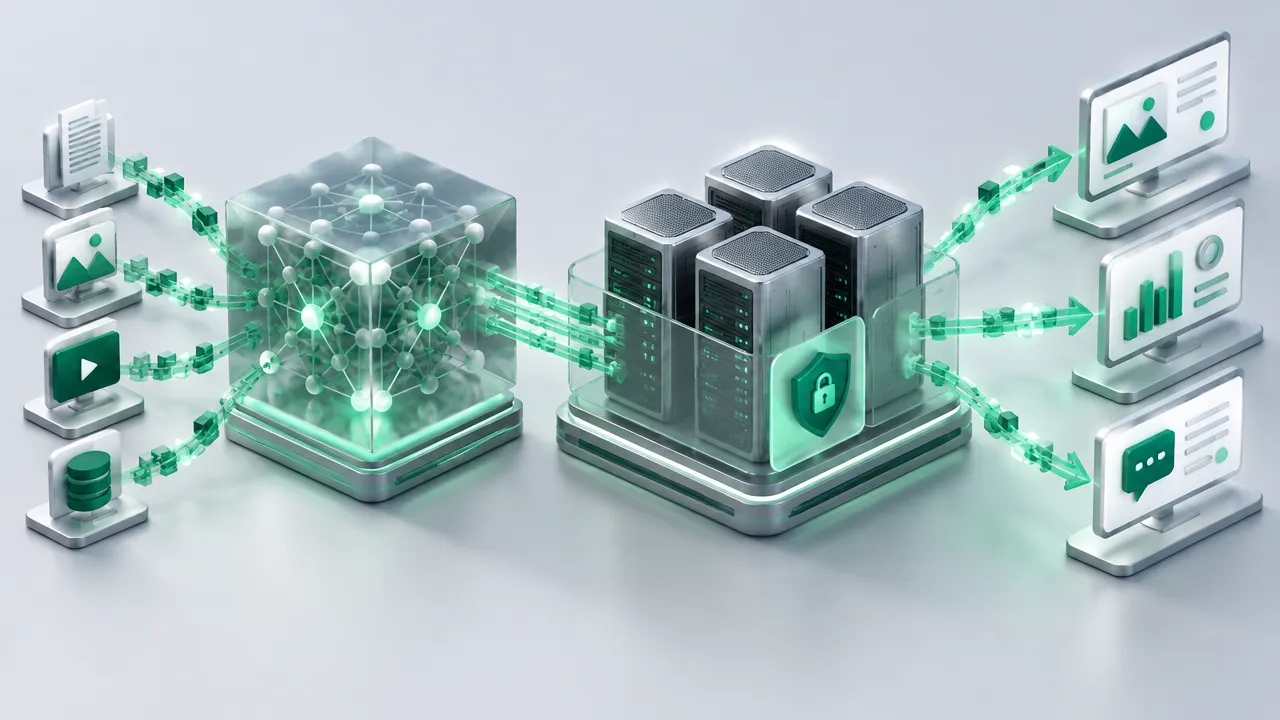
AI inference is the process of using a trained model to produce an output from new input. It is the part of an AI system that users and business applications encounter: a risk score, a classification, a forecast, or a generated response. For teams moving AI into production, understanding inference means understanding both how a model runs and what infrastructure keeps its outputs useful, responsive, and governed.
Key points about AI inference
- Inference applies a model’s learned parameters to new data; it does not update those parameters.
- Traditional models often return a score or label, while generative models produce content step by step.
- Production performance depends on the full request path, including input processing, model execution, serving software, and monitoring.
- Latency, throughput, output quality, cost, and data controls should be evaluated together.
- For regulated workloads, where data is processed and who can access it are part of the deployment decision.
What does inference mean in AI?
Inference is a model’s use of learned patterns to make a prediction or generate an output from data it receives. The input could be a transaction record, a document, an image, or a prompt. The result might be a fraud-risk score, a category, a forecast, or a response in natural language.
A model alone is not a complete application. A production system also needs a way to receive requests, prepare inputs, run the model, return results, and handle failures. That wider process is why inference is often discussed as both a computation and a serving workload.
For example, a bank could pass selected transaction features to a fraud model during an authorization flow. The model returns a risk score, which the application can combine with its own rules or review process. The score is an inference result, not a guarantee that a transaction is fraudulent.
How does a model turn a request into an output?
An inference request is converted into the format a model can process, passed through the model, and translated into an application-ready result. The exact steps depend on the model type, but the core operation is a forward pass through its learned parameters.
- Receive and validate: The application sends input, such as text, structured features, or an image. The serving layer checks that the request is valid.
- Prepare the input: Preprocessing can normalize values, resize an image, or split text into tokens and map those tokens to numerical representations.
- Run the model: The model performs calculations across its layers. In standard inference, those calculations use existing weights rather than changing them.
- Format the result: The system converts the model output into a score, class, text, or another format the application can use.
- Record and monitor: Production systems track service health and relevant quality signals while respecting data access and retention policies.

That final application step matters. A model can return a technically valid output that still needs a threshold, a policy check, or human review before it affects a customer or transaction.
How is inference different from training?
Training adjusts a model’s parameters using data and an optimization process; inference uses the resulting model to answer new requests. Training is usually an iterative development activity. Inference is the repeated execution that happens when an application is in use.
| Dimension | Training | Inference |
|---|---|---|
| Purpose | Learn or update model parameters | Apply learned parameters to new inputs |
| Pattern | Repeated passes over training data | Individual, streaming, or batched requests |
| Main concerns | Training time, data, convergence, and model quality | Latency, throughput, availability, cost, and output quality |
| Typical change | Weights may be updated | Weights normally remain fixed during the request |
The distinction affects infrastructure planning. A team evaluating training versus serving needs may find that the two stages use different schedules, capacity patterns, and performance targets. Some organizations also fine-tune a model, which is a training activity, then deploy the resulting version for inference.
What types of inference do production systems use?
Inference can be organized by when requests arrive and where the model runs. The right pattern depends on whether a task needs an immediate response, can wait for a batch, or must run close to the device or data source.
| Pattern | How it works | Common fit |
|---|---|---|
| Online | Processes requests as applications send them | Interactive assistants, transaction scoring, and document lookup |
| Batch | Processes a collection of inputs together, often on a schedule | Back-office classification, reporting, or document enrichment |
| Streaming | Evaluates a continuous flow of events as they arrive | Event monitoring, sensor feeds, and near-real-time alerts |
| Local or edge | Runs on a nearby device or controlled environment | Low-connectivity settings, local response needs, or data locality requirements |
These patterns can coexist. A bank might score individual transactions online while running a separate batch job to categorize older records. Teams assessing local AI inference should compare the need for low network dependence or local processing with device limits, operational effort, and model update requirements.
How do generative models handle inference?
Generative AI inference produces content from an input, often by predicting one token at a time. In a language model, the system first processes the prompt and then generates a continuation based on the prompt and previously produced tokens.
Serving teams often distinguish between prefill, which processes the input prompt, and decode, which generates the response token by token. These phases can put different demands on compute and memory. A recent research paper describes this two-phase behavior as a source of contention in large-scale model serving, which helps explain why prompt length and response length can affect performance differently. Research on prefill and decode workloads provides more detail.
Inference and reasoning are related but not interchangeable terms. Reasoning describes a model’s task or behavior, while inference is the execution that produces its output. Likewise, generative AI refers to a category of models and applications, while inference is the process that runs those models.
For an AI agent, a single user request may lead to several model calls, tool calls, and intermediate outputs. That makes the full workflow, not just one response, the relevant unit for measuring time and cost.
What turns a model into a production service?
A production inference service connects a model to applications through a reliable request path. It typically includes an API or other interface, input validation, model-serving software, compute resources, access controls, and monitoring.
An inference server accepts requests and routes them to the model runtime. In a banking application, that server might sit behind an internal API that authenticates the calling service, applies request limits, and returns a structured result. Separating the model endpoint from application logic can make it easier to update a model without redesigning every user-facing workflow.
Infrastructure orchestration helps allocate compute, restart failed services, and manage versions as demand changes. Teams choosing an AI inference platform for banking workloads should assess how it handles deployment, observability, access, support, and the organization’s data-location requirements, alongside raw model speed.
Inference engineering covers this operational work: packaging models, configuring serving, measuring performance, controlling releases, and responding to changes in demand or output quality. It connects model development to the service-level expectations of the application.
How should teams measure inference performance?
There is no single number that describes whether an inference system is fast enough. Teams should measure the experience and capacity that matter to the workload, while checking that the model still meets its quality target.
- Latency: How long a request takes to receive a result. For generative services, teams often track time to first token and the delay between later tokens.
- Throughput: How much work the system completes over time, such as requests, records, or output tokens.
- Concurrency: How performance changes when multiple requests arrive at once.
- Quality: Whether outputs continue to meet task-specific accuracy or evaluation criteria.
- Reliability: How often requests succeed and how the service behaves during load spikes or component failure.
Benchmarks are useful when their workload resembles the intended deployment. MLCommons documents inference benchmarks by task and includes details such as datasets, reference accuracy, and latency constraints. The benchmark definitions and scenarios show why comparisons should account for both the tested workload and its quality requirements.
For a bank, a model’s best-case speed on a short prompt may not represent requests that include long customer histories or retrieved documents. A useful benchmark therefore reflects expected input sizes, response limits, concurrency, and the application’s acceptable delay.

Which GPU and optimization choices affect serving?
GPU selection should follow the model, request pattern, and service target rather than a hardware label alone. Memory capacity can limit which model and context sizes fit, while compute and memory bandwidth affect how quickly requests can be processed.
Teams choosing an inference GPU should test the intended model with representative prompts, concurrency, and precision settings. Quantization can reduce memory use and improve throughput, but it may change output quality, so each configuration needs validation against the application’s acceptance criteria.
Other optimization methods include batching requests, reusing cached data where appropriate, controlling maximum input and output lengths, and separating workloads with different service goals. Optimization should be measured end to end because a faster model runtime may not reduce total response time if preprocessing, networking, or downstream checks dominate.
What drives inference costs?
Inference cost depends on how much compute a workload consumes and how efficiently the service uses it. Request volume is only one factor: model size, prompt and output length, concurrency, idle capacity, and the serving configuration can all change the total.
Budgeting should start with a representative request profile. Teams can estimate expected daily volume, typical and peak concurrency, input and output size, and how much capacity must remain available during quiet periods. They should then measure actual consumption under realistic load rather than relying only on a model’s parameter count.
- Separate interactive traffic from jobs that can run in batches.
- Track utilization alongside response time and output quality.
- Test whether batching or smaller model variants meet the required quality target.
- Include operational costs such as storage, networking, support, and capacity reserved for peaks.
Teams evaluating inference costs should also examine billing units and data-transfer charges. An hourly GPU model can make short-lived experiments and variable demand easier to account for, but a cost comparison still needs the same workload, service target, and included services on both sides.
How do privacy, governance, and data location fit in?
Inference can expose sensitive information because applications send live data to a model-serving environment. Regulated organizations should define which data enters each request, who can access it, how it is logged, how long it is retained, and where processing occurs.
Keeping compute and data in Brazil can help organizations reduce cross-border data movement and align infrastructure choices with internal governance and LGPD obligations. Location alone does not establish compliance: access controls, security practices, retention, vendor terms, and the application’s purpose also matter.
NIST’s AI Risk Management Framework treats risk management as relevant across the design, development, deployment, use, and evaluation of AI systems. Its guidance can help teams structure governance and operational reviews throughout that lifecycle. NIST’s AI risk framework is voluntary guidance, not a substitute for legal review or sector-specific controls.
Some teams explore privacy-preserving methods such as confidential execution or zero-knowledge techniques. These approaches address different technical problems and should not be treated as interchangeable guarantees. A deployment assessment should state the threat model, the information protected, and what evidence the method can actually provide.
How does managed GPU infrastructure support production inference?
Managed GPU infrastructure can reduce the operational work involved in provisioning accelerators, orchestrating workloads, and adapting capacity to demand. It is relevant when teams need GPU-backed serving but do not want to build and maintain every layer of the environment themselves.
Nuplia provides managed GPU-as-a-Service and sovereign AI inference infrastructure in Brazil for organizations running production AI workloads. Its service includes elastic, hourly billed NVIDIA GPU capacity, including RTX PRO 6000 Blackwell GPUs for inference and fine-tuning, with Kubernetes and GPU orchestration.
For organizations evaluating deployment options, Nuplia also offers contractual support in Portuguese, invoicing in BRL with NF-e, and zero egress fees. These operational terms can be considered alongside model fit, latency testing, governance requirements, and the workload’s actual cost profile.
The appropriate choice depends on the service being built. A small internal classification endpoint, a high-concurrency conversational assistant, and a batch document pipeline do not necessarily need the same GPU configuration or operating model.
What should teams validate before launch?
A production readiness review should test the model and the service together. It should confirm that expected requests produce acceptable outputs at the required speed, while the infrastructure and governance controls behave as intended.
- Define the task, user impact, and acceptable output quality.
- Choose online, batch, streaming, local, or mixed processing based on the workflow.
- Benchmark realistic inputs, output lengths, concurrency, and peak demand.
- Measure latency, throughput, reliability, utilization, and cost under the same test conditions.
- Set access, logging, retention, and incident-response rules for production data.
- Establish how teams will monitor quality, roll back a release, and respond to service degradation.
Inference is the point where model capability meets operational reality. A model becomes useful in production when its outputs fit the task and the system around it can deliver them with predictable performance, accountable controls, and a cost the organization can sustain.