
AI infrastructure providers should be compared by how well they support a specific production workload, not by a generic ranking. For banks, fintechs, and other regulated organizations, the decision also depends on data location, operational support, platform fit, and the full cost of running models.
A useful comparison starts with the infrastructure layer each provider supplies, then tests it against real workload requirements. This approach helps teams shortlist options that can meet performance, governance, and budget needs.
Key points for evaluating providers
- Compare like with like: hardware, cloud capacity, orchestration software, and managed services solve different problems.
- Test representative production workloads instead of relying on headline specifications or unrelated benchmarks.
- Verify where data, logs, backups, and operational access are handled, not only where the main server is located.
- Calculate total cost across compute, storage, networking, idle capacity, support, and billing terms.
- Check whether the provider can support deployment, monitoring, incident response, and future scaling.
Start by identifying the infrastructure layer each provider owns
AI infrastructure covers the compute, storage, networking, and software needed to train or serve models. Companies may provide one layer or combine several, so a shortlist is only meaningful when the options perform comparable roles.
| Provider model | What it typically supplies | Useful comparison question |
|---|---|---|
| Compute infrastructure | GPU servers or virtual machines | Can the hardware run the target model at the required scale? |
| Managed GPU platform | GPU capacity with orchestration and operational support | How much cluster setup and maintenance remains with the customer? |
| Data center or colocation service | Facility, power, cooling, and physical connectivity | Who manages the servers, platform, and failures? |
| Software and orchestration layer | Scheduling, deployment, monitoring, or model-serving tools | Does it work with the organization’s existing stack? |
| Integrated infrastructure service | A combination of compute, platform, and support | Are responsibilities and service boundaries clear? |
This distinction matters because the largest infrastructure operator is not automatically the right provider for a particular workload. A team seeking managed inference, for example, may value Kubernetes operations and incident support more than access to a large general-purpose cloud catalog.
Test the platform with a representative workload
A short workload test gives a more useful comparison than a specification sheet. Use the intended model, serving framework, request pattern, and data shape, then record results under steady and peak demand.
Measure response latency, throughput, startup time, GPU utilization, and behavior during failures or traffic spikes. Keep model versions, request sizes, concurrency, and test duration consistent across providers. Otherwise, a benchmark may reflect different test conditions rather than a meaningful infrastructure difference.
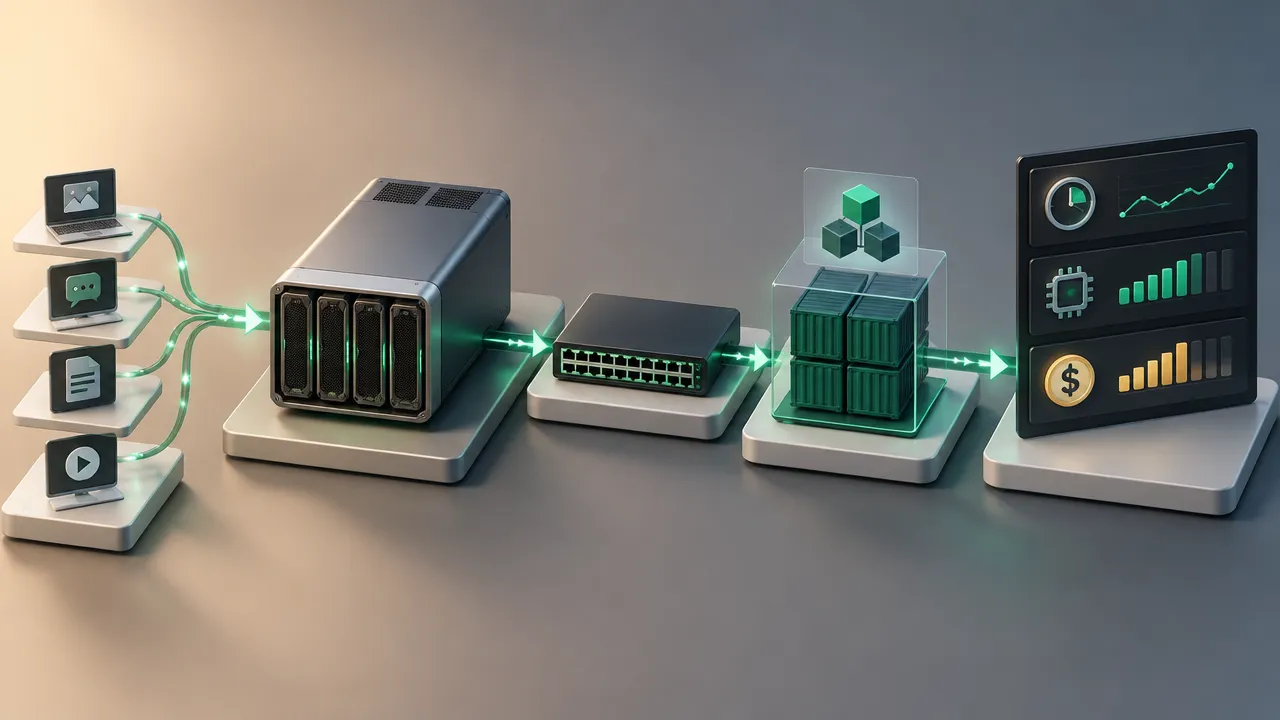
Include the operational path as well as raw compute. Teams deploying generative AI or agent workloads should test how the platform handles parallel requests, retries, longer-running tasks, and the supporting services those workloads need.
Verify data location, access, and compliance responsibilities
For regulated workloads, data residency requires more than checking the location of the primary GPU server. Review where prompts, outputs, logs, backups, telemetry, and support records are stored, and who can access them during normal operations and incident response.
Brazil’s ANPD sets rules for international transfers of personal data, including mechanisms such as adequacy decisions and contractual safeguards. The ANPD international transfer regulation is a useful reference when teams map data flows and responsibilities. A local processing location can support a sovereignty strategy, but organizations still need to assess actual transfers and their legal basis.
Ask each provider to document data paths, subprocessors, backup locations, access controls, retention, and deletion processes. These details help legal, security, and infrastructure teams assess risk together instead of treating compliance as a checkbox at the end of procurement.
Compare the platform and its operating model
Production infrastructure includes the tools and people required to keep workloads available. Compare Kubernetes compatibility, GPU scheduling, deployment workflows, monitoring, capacity scaling, and the process for resolving incidents.
Teams should also define who owns each operational task. A provider may supply compute while the customer handles cluster upgrades, model serving, security configuration, and on-call response. A managed service may take on more of that work, but the contract should make the boundary explicit.
Governance can be included in the same review. The voluntary NIST AI Risk Management Framework organizes risk work around functions such as mapping, measuring, and managing. Infrastructure teams can use those categories to structure questions about workload context, monitoring, and risk response.
Calculate total cost for the workload, not just the GPU hour
GPU hourly pricing is only one part of infrastructure cost. A realistic estimate should include storage, networking, data transfer, idle capacity, orchestration, support, minimum commitments, billing currency, and applicable taxes.
Model the expected workload over a normal month, including deployment tests, quiet periods, and demand peaks. Ask whether capacity can scale down when it is not needed, whether billing is granular, and whether network transfer creates additional charges. Comparing the same workload and billing period makes the financial trade-offs clearer.
Nuplia offers elastic, hourly billed GPU capacity in Brazil, including RTX PRO 6000 Blackwell GPUs for inference and fine-tuning, with Kubernetes and GPU orchestration. Its service also includes Portuguese-language contractual support, invoicing in BRL with NF-e, and zero egress fees, which can make those cost and operating terms easier to assess as part of a provider comparison.
Use a consistent scorecard before choosing
A scorecard helps procurement, engineering, security, and finance evaluate the same evidence. Rate each shortlisted option against the organization’s requirements, and record the proof behind every rating rather than relying on sales presentations.
| Evaluation area | Evidence to request |
|---|---|
| Workload fit | Results from a repeatable test using the intended model and traffic pattern |
| Data control | Documented locations and access rules for data, logs, backups, and telemetry |
| Platform operations | Clear responsibility for orchestration, upgrades, monitoring, and incidents |
| Cost predictability | Estimated monthly bill with usage assumptions and all material charge types |
| Service readiness | Support channels, escalation steps, service commitments, and contract terms |
The strongest choice is the provider that meets the workload’s technical and governance requirements with an operating model the organization can sustain. Revisit the comparison when models, traffic, regulation, or deployment needs change, because those shifts can alter both cost and risk.